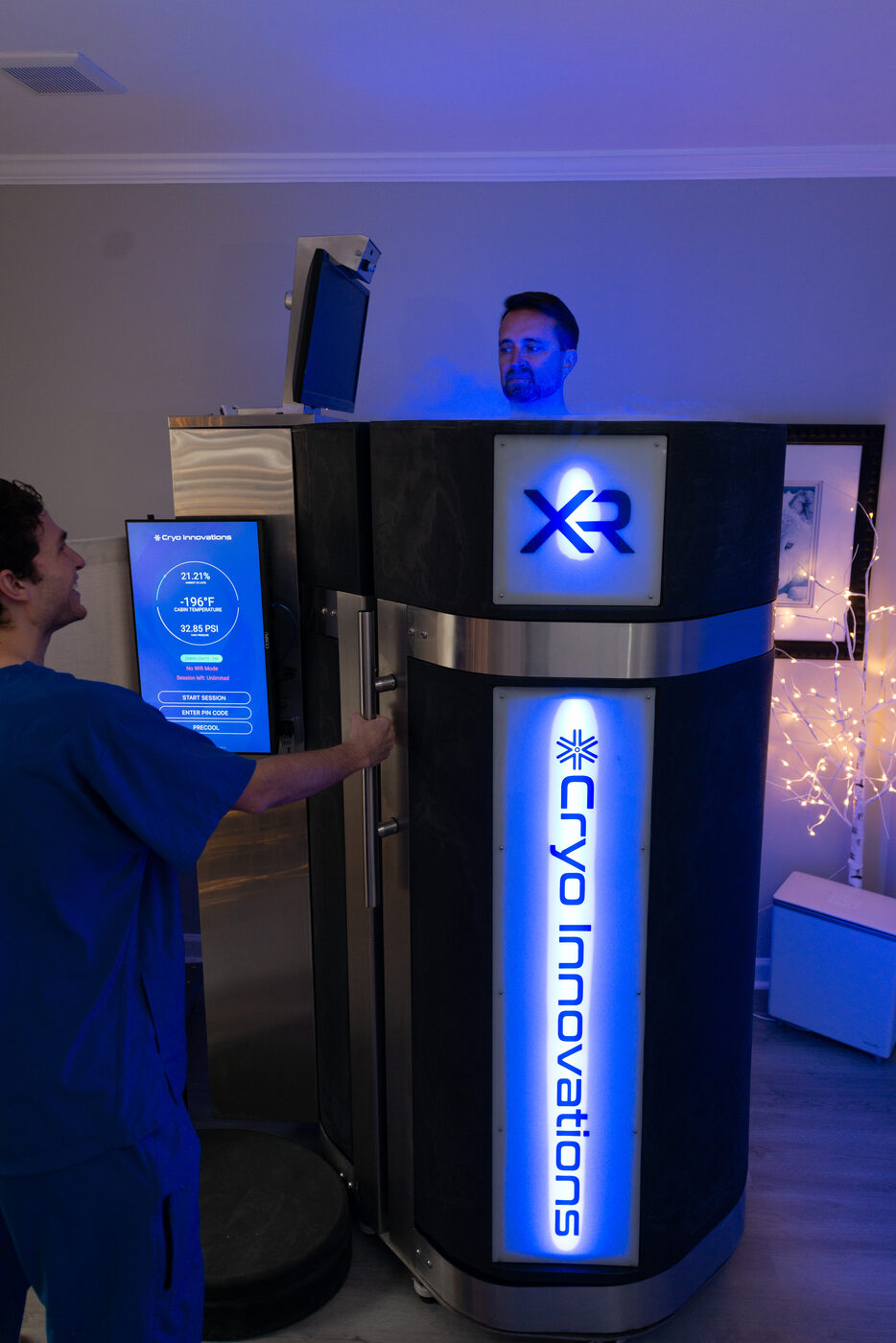
Cryotherapy
Written by Dr. Lori Martin, M.D., Medical Director, THRIVE 4 Peak Performance. Dr. Martin specializes in performance medicine, longevity medicine, and recovery therapeutics.
Related reading: Cryotherapy in Alpharetta | Whole Body Cryotherapy Guide | Compression Modality
Whole body cryotherapy has moved from elite-athlete curiosity to mainstream wellness tool — and with that mainstream adoption has come a flood of conflicting advice about how often you should actually be stepping into a cryo chamber. Daily? Weekly? Only on hard training days? The honest answer is that the ideal frequency depends entirely on what you're trying to accomplish.
At THRIVE 4 Peak Performance in Alpharetta, we program cryotherapy protocols based on each client's specific goals, training load, injury history, and overall recovery capacity. Below is the physician-level framework we use to dial in cryotherapy frequency — including the science behind why more is not automatically better.
Whole body cryotherapy exposes the skin to temperatures around -220°F to -250°F for 2 to 3 minutes. That thermal shock triggers a predictable cascade of physiological responses: peripheral vasoconstriction, a sharp spike in norepinephrine (often 200–300% of baseline), activation of cold-shock proteins, and a systemic anti-inflammatory response mediated by reduced pro-inflammatory cytokines.
Every one of those responses is an adaptive stress — and the body adapts on a dose-response curve. Too little cryotherapy and you don't accumulate enough stimulus to see measurable benefit. Too much, and you start to blunt the very inflammatory processes that drive muscle growth, tissue repair, and metabolic adaptation to training. Frequency, in other words, is the most important programming variable — and it's the one most people get wrong.
The right cadence depends on what you're optimizing for. Here's how our physician team at THRIVE typically structures protocols:
For athletes and high-volume trainers, 2–4 cryotherapy sessions per week — ideally scheduled in the hours immediately after hard training — provide meaningful reductions in delayed-onset muscle soreness, perceived fatigue, and inflammatory markers. Avoid cryotherapy in the 4-hour window immediately after hypertrophy-focused resistance training, where the anti-inflammatory response can blunt muscle-building signaling.
For clients managing chronic inflammatory conditions, low-grade systemic inflammation, or persistent joint and soft-tissue pain, the strongest published protocols use higher-frequency exposure — typically 3 to 5 sessions per week for an initial 2- to 4-week loading phase, followed by a maintenance cadence of 1–2 sessions per week. This schedule accumulates enough anti-inflammatory stimulus to meaningfully shift symptoms.
For clients using cryotherapy primarily for mood, energy, and general wellness benefits — the norepinephrine-driven lift, improved sleep quality, and mental clarity — one to two sessions per week tends to be the sweet spot. This cadence captures the neurochemical benefits without requiring a major time investment.
For clients pursuing cryotherapy as part of a longevity and metabolic-health stack, once-weekly sessions deliver consistent hormetic stress without overtraining the body's adaptive systems. This frequency pairs well with our other longevity modalities including mild hyperbaric oxygen modality and NAD+ IV "Drip".
In the first 72 hours following an acute musculoskeletal injury, multiple short daily exposures can be appropriate. This is a short-term protocol — not a long-term frequency — and should always be structured by a clinician familiar with your injury.
One of the most common misconceptions about cryotherapy is that if some is good, more must be better. That's not how hormesis works. Hormetic stressors — cold, heat, fasting, exercise — follow an inverted-U dose-response curve: the benefit rises with dose up to a point, then plateaus, then actually declines as the dose keeps increasing.
With cryotherapy specifically, two mechanisms create the downside of overuse:
If you're new to cryotherapy, the initial adaptation phase matters. At THRIVE, we generally recommend new clients start with the following structure:
We also track subjective and objective markers during the onboarding phase, including heart rate variability, sleep quality, perceived recovery, and any training-performance indicators relevant to the client's goals. Cryotherapy is one of the rare modalities where most clients can feel the neurochemical shift after a single session — which makes it unusually easy to personalize.
Cryotherapy rarely lives in isolation for our clients. The most common stacks we program at THRIVE combine cryotherapy with complementary recovery and performance modalities — and those combinations affect your ideal cryotherapy frequency.
If you're already doing frequent NormaTec compression modality or red light modality, you may be able to reduce cryotherapy frequency because the recovery stimulus is already being delivered through other channels. Conversely, if cryotherapy is your primary recovery tool, frequency at the upper end of the ranges above tends to produce the best results.
For a full breakdown of how we stack these modalities, see our Recovery Stack Guide.
THRIVE Tech supervised cryotherapy at THRIVE 4 Peak Performance. Same-week scheduling available at our Alpharetta clinic on Old Milton Pkwy.
Book an Appointment Call (470) 359-6195For most clients, daily cryotherapy is unnecessary and not the most effective frequency. Short-term daily exposure can be appropriate for acute injury protocols, but daily sessions as a long-term habit can blunt muscle-building adaptations and, in some clients, create autonomic or sleep disruption. Most clients see the best results from 2–4 sessions per week.
Most clients feel the acute neurochemical effects — a lift in mood, mental clarity, and energy — within minutes of their first session. Recovery and inflammation benefits compound over a series of sessions, with most clients noticing meaningful changes within 2–4 weeks of a consistent protocol.
Morning or early afternoon generally works best, given the alerting effect of the norepinephrine response. For athletic recovery, scheduling sessions within a few hours after hard training maximizes the anti-inflammatory benefit — with one caveat: avoid the 4-hour window immediately following hypertrophy-focused resistance training, where the anti-inflammatory signal can interfere with muscle-building adaptations.
Yes — and this is a common approach. Stacking cryotherapy with modalities like compression modality, red light modality, HOCATT, or an IV infusion allows clients to compress a full recovery protocol into a single visit. Our team can design a combined session that fits your schedule and goals.
Cryotherapy is not appropriate for clients with certain cardiovascular conditions, uncontrolled hypertension, Raynaud's phenomenon, cold urticaria, or pregnancy, among other conditions. Every new client at THRIVE completes a brief clinical screening before their first session to confirm suitability and personalize the protocol.
THRIVE 4 Peak Performance is located at 3568 Old Milton Pkwy, Alpharetta, GA 30005. We serve Alpharetta, Milton, Roswell, Johns Creek, and Cumming. Call (470) 359-6195 to schedule your cryotherapy appointment.