Cryotherapy & Recovery
Written by Dr. Lori Martin, M.D., Medical Director, THRIVE 4 Peak Performance. Dr. Martin specializes in performance medicine, longevity medicine, and recovery therapeutics.
Related reading: Whole Body Cryotherapy in Alpharetta | How Often Should You Do Cryotherapy? | The Performance Recovery Stack
Cold exposure has gone from niche athlete ritual to one of the most-discussed wellness trends of the decade. Walk through any gym, recovery studio, or social feed in Alpharetta and you'll hear the same two modalities mentioned almost interchangeably: cold plunge and whole body cryotherapy. They look similar from a distance. They are not the same thing — and the differences matter for what they do inside your body, who benefits most from each, and how to use them safely.
At THRIVE 4 Peak Performance, we routinely answer this exact question for new clients. Below is the physician-level breakdown we walk through in the consult room, so you can choose the cold modality — or combination — that actually fits your goals.
Cold plunge (ice bath) and whole body cryotherapy both deliver cold exposure as a hormetic stressor, but they do it through fundamentally different mechanisms. Cold plunge uses water conduction at 38–55°F for 2–10 minutes. Cryotherapy uses dry, nitrogen-cooled air at roughly -220°F to -250°F for 2 to 3 minutes. The water modality is a deeper, longer-duration thermal load. The cryo modality is a shorter, more intense surface-level shock. Both have legitimate evidence behind them — they're just optimizing different parts of the recovery response.
Water transfers heat away from the body roughly 25 times more efficiently than air. That's the single most important fact in this comparison, because it explains why a 45°F cold plunge can feel as physiologically demanding as -240°F cryotherapy despite the massive temperature gap.
In a cold plunge, your body is in direct contact with cold water across nearly the entire skin surface. Heat leaves the body quickly, core temperature begins to drop within minutes, and the body responds with strong peripheral vasoconstriction, a sustained sympathetic-nervous-system spike, and — if exposure is long enough — measurable shifts in brown adipose tissue activity and metabolic rate.
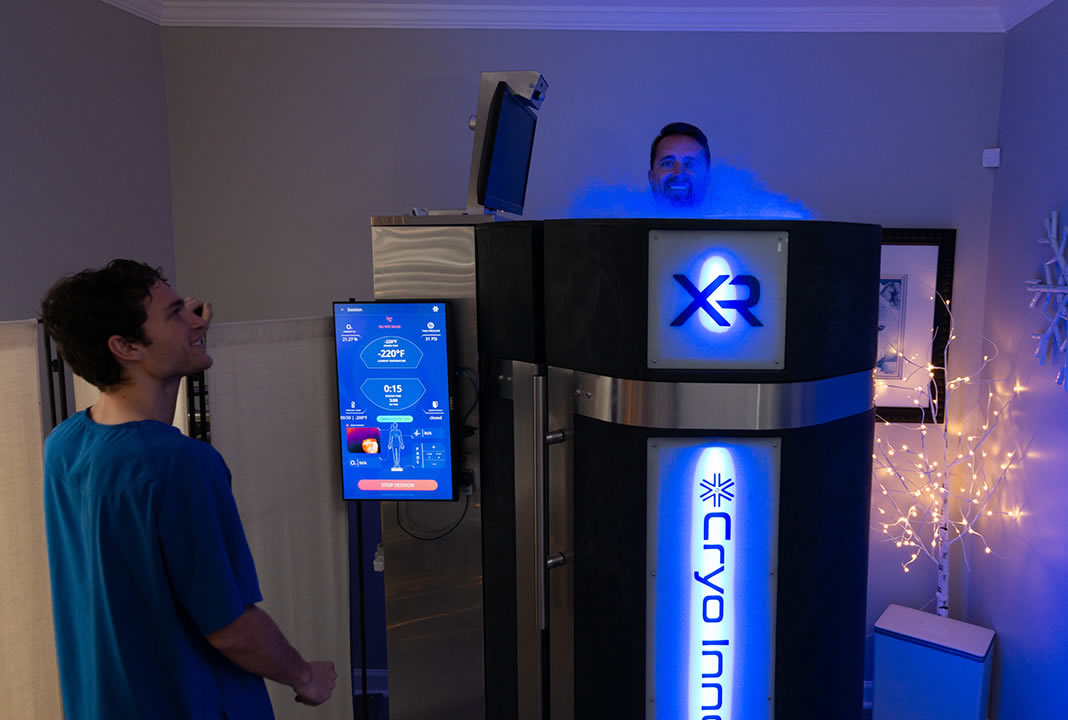
In whole body cryotherapy, your body is exposed to extremely cold but dry air for a very short window. Skin temperature drops sharply, but core temperature stays nearly stable. The benefit comes primarily from a high-amplitude norepinephrine release, cold-shock protein activation, and a systemic anti-inflammatory response — without the prolonged thermoregulatory load of an ice bath.
In simple terms: cold plunge taxes the whole thermoregulatory system; cryotherapy delivers a neurochemical and anti-inflammatory pulse without dropping core temperature. Both are useful. They're not redundant.
| Factor | Cold Plunge / Ice Bath | Whole Body Cryotherapy |
|---|---|---|
| Temperature | 38–55°F water | -220°F to -250°F dry air |
| Session length | 2–10 minutes | 2–3 minutes |
| Heat transfer medium | Water (≈25× faster than air) | Dry air |
| Core temperature impact | Measurable drop | Minimal — skin-level only |
| Primary mechanism | Thermoregulatory load, BAT activation, mental resilience | Norepinephrine surge, anti-inflammatory pulse, cold-shock proteins |
| Best for | Metabolic adaptation, stress tolerance, sustained mood lift | Post-training recovery, inflammation, time-efficient sessions |
| Comfort | More uncomfortable — full water immersion | More tolerable — dry, brief exposure |
| Time commitment | 10–20 min including changing | 10–15 min total visit |
Both modalities work. The right choice — or the right combination — depends on what you're optimizing for. Here's how we typically guide clients at THRIVE:
Post-training recovery on a tight schedule, inflammation and joint pain, mood and energy on demand, time-efficient sessions you can stack with other modalities, and clients who don't tolerate full-water immersion. The brevity and intensity make it the easier modality to be consistent with — which is the variable that drives results.
Building stress tolerance and mental resilience, metabolic adaptation and brown adipose tissue stimulation, a longer-duration meditative practice, and clients training the discomfort tolerance itself. Cold plunge tends to deliver a longer-lasting subjective mood lift after a single session, but at a steeper time and discomfort cost.
Serious athletes, longevity-focused clients, and anyone building a comprehensive recovery practice. The two modalities don't fully overlap — using both, on different days or for different phases of a training block, lets you capture distinct adaptations. We help clients sequence this inside a broader recovery stack.
Three myths come up in nearly every consult, and they're worth correcting up front:
Both modalities are well-tolerated by most healthy adults, but cold exposure is not appropriate for everyone. Clients with certain cardiovascular conditions, uncontrolled hypertension, Raynaud's phenomenon, cold urticaria, or pregnancy should not use either modality without medical clearance. Even outside those categories, individual response to cold varies significantly — which is why every new THRIVE client completes a brief clinical screening before their first cryotherapy session.
Cold plunge at home carries an additional consideration: cardiovascular response to sudden full-body water immersion can be intense, and the cold-shock response can be dangerous in the wrong client. A physician conversation before starting an aggressive home protocol is well worth the 15 minutes.
For most of our Alpharetta clients, cryotherapy isn't a standalone intervention — it's one component of a broader recovery and performance plan that may also include mild hyperbaric oxygen modality, red light modality, NormaTec compression modality, and targeted IV nutrient modality. The combination matters because each modality is optimizing a different bottleneck in recovery — and a well-designed protocol is far more powerful than any single tool in isolation.
THRIVE 4 Peak Performance offers physician-screened whole body cryotherapy on Old Milton Pkwy. Same-week scheduling available — and our team can help you decide whether cryotherapy, cold plunge, or a combined approach fits your goals.
Book an Appointment Call (470) 359-6195Both produce measurable post-exercise recovery benefits. Cryotherapy is typically more time-efficient and easier to be consistent with, while cold plunge produces a longer thermoregulatory load. For most clients, the better question is which one you'll actually use 2–3 times per week — consistency drives results far more than the choice of modality.
Despite the much lower air temperature, most clients report cryotherapy as more tolerable than a cold plunge. Water transfers heat away from the body roughly 25 times faster than air, so 40°F water feels physiologically more demanding than -240°F dry air over a comparable duration.
It's possible, but it's usually not the most effective programming. Stacking two high-intensity cold exposures in a single day can blunt training adaptations and overdose the hormetic stress signal. Most clients see better results separating modalities across different days or using one as the primary protocol with the other as occasional variation.
They produce overlapping but distinct effects, so "as effective" depends on the outcome you care about. At-home cold plunge is a legitimate tool. THRIVE Tech supervised cryotherapy adds a different mechanism, individualized programming, screening for contraindications, and integration with other recovery modalities you can't replicate at home.
The simplest path is a brief consult with our physician team at THRIVE 4 Peak Performance. We screen for contraindications, talk through your goals — recovery, performance, longevity, stress resilience — and recommend a starting protocol you can actually sustain. Call (470) 359-6195 to schedule.
THRIVE 4 Peak Performance is located at 3568 Old Milton Pkwy, Alpharetta, GA 30005. We serve Alpharetta, Milton, Roswell, Johns Creek, and Cumming. Call (470) 359-6195 to schedule your cryotherapy appointment.